
Electronic Chart Display and Information Systems (ECDIS Course)
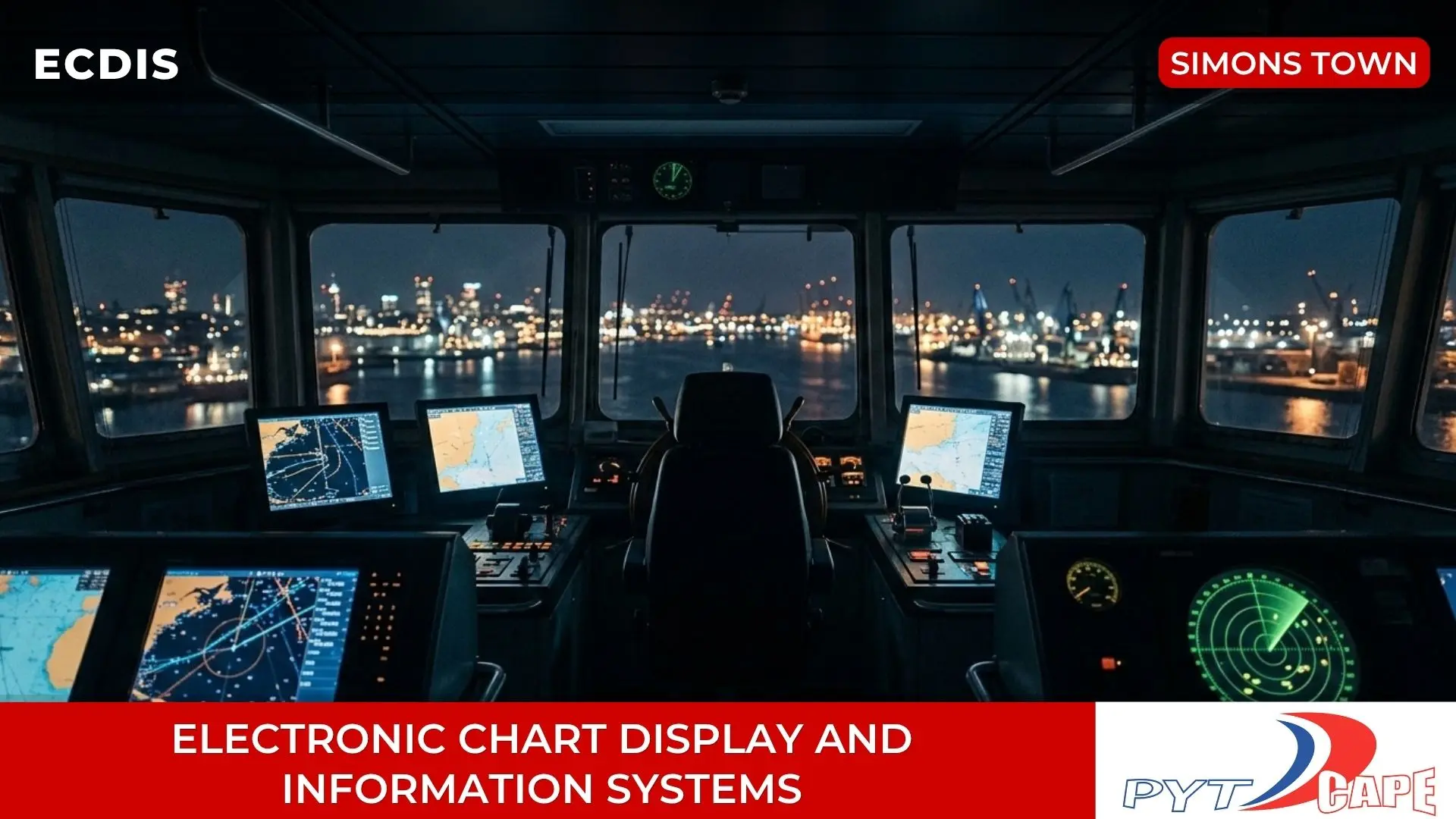
Forty hours that stand between an Officer of the Watch and a Chief Mate or Master 500/3000GT ticket.
What the ECDIS course covers
Paper charts are no longer the primary means of navigation on most commercial vessels, and the MCA has adjusted its requirements accordingly. If your vessel navigates primarily on ECDIS, you need generic ECDIS training to keep a watch on it. If you intend to progress within the MCA Yacht Officer system, from Officer of the Watch to Chief Mate and then to Master 500 and 3000t, you need it to qualify.
ECDIS is a geographic information system built for nautical navigation. For it to be used as a legal alternative to paper charts rather than merely alongside them, the system has to comply with IMO regulations, and the watchkeeper has to be trained to the IMO standard.
This is not a familiarisation session. Forty hours over five days, delivered to IMO Model Course 1.27, covering the system in enough depth that you understand what it is telling you and, more importantly, when it is telling you something wrong.
That second part is the real content. ECDIS presents information with enormous confidence, including when the underlying chart data is out of date, the safety contour has been left on a default setting, or the alarms have been configured to stop bothering anyone. Several well-documented groundings came down to a watchkeeper trusting a display that was configured badly. The course exists to make sure you are not that watchkeeper.
The course runs at the SAMTRA premises in Simon's Town, the same facility used for the OOW and Master modules. If you are stacking qualifications on one trip, everything happens on one site.
ECDIS Course Content
Five days, largely hands-on at the workstation. Theory is introduced and applied immediately.
ECDIS as a legal equivalent to paper
Carriage requirements, what constitutes an approved system, and the conditions under which ECDIS may legally replace paper charts. Backup arrangements and what happens when the primary system fails.
Electronic charts and their limitations
ENC and RNC formats, vector and raster data, chart scale and the difference between the scale you are viewing and the scale the data was compiled at. Zones of confidence, and how to read the reliability of what you are looking at.
Chart updating and licensing
Obtaining, installing and verifying updates. Permit management, licence expiry, and confirming a chart is actually current rather than assuming it.
System setup and safety settings
Safety depth, safety contour, shallow and deep contours, and how those settings change what the display shows you. The single most consequential part of the course, because a default safety contour is how vessels end up on charted ground.
Alarms and indications
What the system warns about, what it does not, and the alarms people routinely disable. Configuring alerts so they remain useful rather than becoming background noise.
Route planning and monitoring
Planning a passage on ECDIS, checking it against the chart data, cross-track limits, and monitoring the plan underway. Handling deviations and amending a plan on watch.
Sensor inputs and integration
GNSS, gyro, log, AIS and radar overlay. What each contributes, what the system does when one fails, and recognising a sensor error rather than accepting it as fact.
Errors, anomalies and failure modes
Datum issues, positional offsets, display anomalies and known system limitations. What to do when the display and the view from the window disagree.
Records and watch keeping practice
Voyage recording, logging, handover and the practical discipline of keeping a watch on an electronic system.
Where the ECDIS course certificate takes you
ECDIS sits on the officer progression route rather than the entry route. For most people holding it, the sequence runs OOW, then ECDIS, then Chief Mate, then Master 500 and 3000t. Without it, that progression stops.
It is also increasingly a condition of employment in its own right. Vessels navigating primarily on ECDIS need watchkeepers certified on it, and a candidate without the certificate is simply not eligible for the watch.
One thing worth understanding clearly: generic training is not the whole requirement.
This course is the generic ECDIS certificate, recognised internationally and delivered to the IMO standard. Certain flag states also require type-specific training on the particular ECDIS installed aboard your vessel, usually delivered as a short manufacturer-specific module.
The two are not interchangeable and neither replaces the other. Generic training gives you the understanding. Type-specific training teaches you which menu on that make and model does what. Do the generic course once, and the type-specific module each time you join a vessel with an unfamiliar system under a flag that requires it.
On availability. Every 2026 intake sold out. The 2027 calendar runs roughly monthly with nine dates, but this course fills earlier than most, largely because candidates book it around an OOW block rather than in isolation.
