
Master 500gt / 3000gt
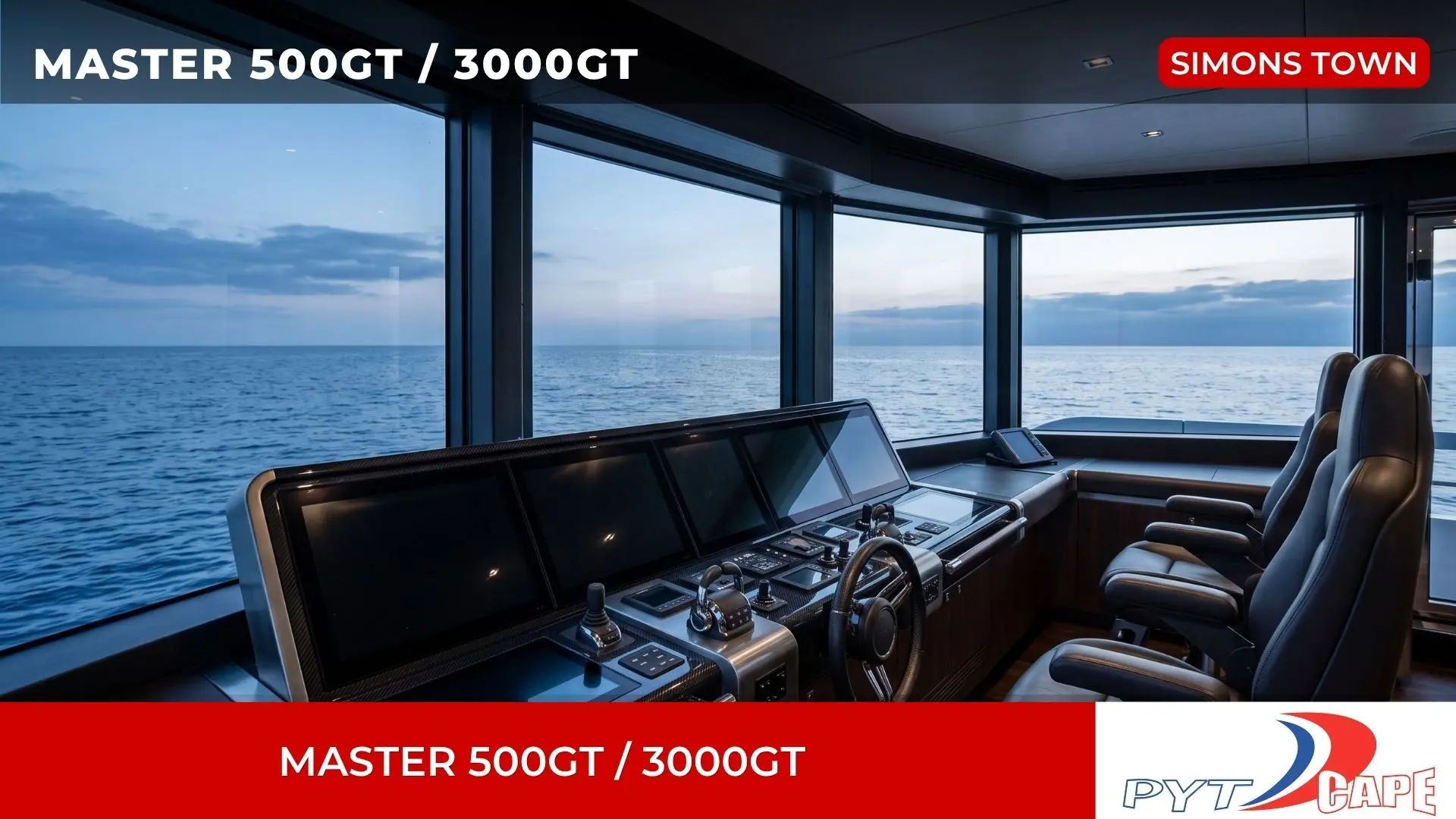
The five MCA modules that take you from Officer of the Watch to Master, delivered back to back or one at a time.
What the Master 500gt course covers
Master 500gt/3000gt is not a course. It is five separate MCA modules, each examined in its own right, which together satisfy the academic requirement for progression from Officer of the Watch to Master.
That structure is deliberate and it works in your favour. You do not have to clear thirty days at once. Modules can be taken individually as sea time and leave allow, which is how most working officers get through them. Or you can book the block and finish in a single stretch.
The five modules
| Module | Days | Individual |
|---|---|---|
| Advanced Navigation and Radar | 10 | US$3,100 |
| Seamanship and Meteorology | 5 | US$1,550 |
| Stability | 5 | US$1,550 |
| Business and Law | 5 | US$1,550 |
| Masters Celestial (Hout Bay) | 5 | US$1,550 |
Back-to-back package: US$6,975 excluding Celestial. Taken individually the same four modules come to US$9,300, so the package saves US$2,325.
Booked individually the five come to US$9,300. The back-to-back package is US$6,975, excluding Celestial, which saves US$2,325 against taking the same four separately.
Where they are taught. Four modules run at SAMTRA, the South African Maritime Training Academy, in Simons Town. Masters Celestial runs at Hout Bay.
Who teaches them. These are examined modules with a real failure rate, and the difference between a lecturer who knows the syllabus and one who knows the examination is measurable in pass rates. The modules are delivered by lecturers with substantial experience of both the subject matter and what the examiners are looking for.
Master 500gt Course Content
Advanced Navigation and Radar (10 days)
The longest and most demanding module, and the one people re-sit most often. Radar and ARPA in depth, plotting, collision avoidance at a level beyond OOW, blind pilotage, advanced passage planning, and navigating in restricted visibility and confined waters.
Ten days and US$3,100, which reflects both the length and the weight it carries in the overall qualification.
Seamanship and Meteorology (5 days)
Two subjects in one module. The seamanship element covers anchoring and mooring at scale, towing, heavy weather handling, cargo and stores, and the practical command decisions a master makes rather than delegates. Meteorology goes well beyond a coastal forecast into synoptic analysis, ocean weather systems, tropical revolving storms and routing.
Stability (5 days)
The module officers find hardest and the one most directly concerned with not sinking. Transverse and longitudinal stability, GM and GZ curves, free surface effect, loading and ballasting, trim, list, and the calculations a master signs off on before sailing. Numerical throughout.
Business and Law (5 days)
The commercial and legal responsibilities of command. Flag state and port state control, certification and survey requirements, charter parties, crew employment and discipline, insurance and liability, salvage, and the master's legal position when things go wrong.
Masters Celestial (5 days)
Celestial navigation at Master level. Sextant work, sight reduction, star and planet sights, great circle and composite sailing, and ocean passage planning without electronic position fixing. Taught at Hout Bay rather than Simons Town.
Priced separately at US$1,550 and excluded from the back-to-back package.
Where the Master 500gt certificate takes you
Master 500gt/3000gt is the senior deck qualification in the yachting sector. Above OOW, above Chief Mate, and the ticket that puts you in command of the vessels most people are aiming at when they start.
The modules are the academic component. They sit alongside qualifying sea service, the relevant ancillary certificates including ECDIS and PSCRB, and an oral examination. Completing the five modules is significant progress rather than the finish line, and worth planning as a campaign rather than a booking.
On sequencing. Advanced Navigation and Radar is the heaviest module and the one that benefits most from recent watchkeeping. Stability is the one candidates most often want to take twice. Plan the order around your own weak subjects rather than the calendar.
On the calendar. Modules are grouped into blocks running roughly every six to eight weeks, so back-to-back candidates complete in about five weeks. Individual modules can be picked off from any block. Celestial runs on its own schedule, more frequently than the block cycle.
