
OOW (Officer of the Watch)
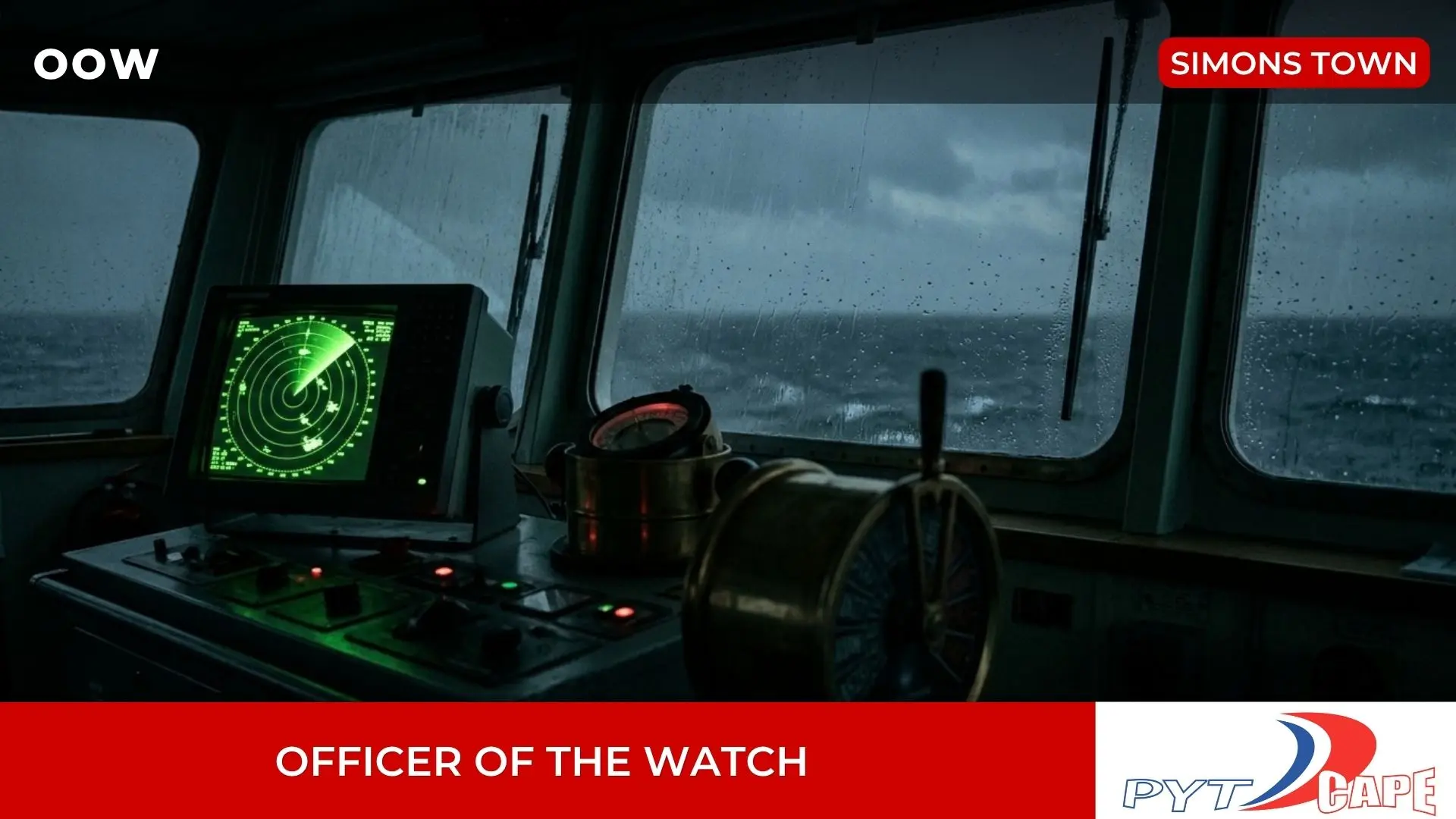
The modules that qualify you to stand a bridge watch in your own right, and the point at which a deck career becomes an officer's career.
What this course covers
Officer of the Watch is where the responsibility shifts. Below it you are crew, working under someone else's judgement. Holding OOW means the bridge is yours for four hours at a time, and every decision made during those four hours is yours to make and yours to answer for.
The MCA does not issue this as a single course. It is a set of separately examined modules, and what we deliver here is the academic component of the certificate.
OOW modules
| Module | Days | Individual |
|---|---|---|
| Navigation, Radar and ARPA | 15 | US$4,200 |
| General Ship Knowledge (GSK) | 5 | US$1,550 |
| HELM (Operational) | 3 | US$840 |
| PSCRB (Hout Bay) | 3 | US$840 |
Back-to-back package: US$6,687 Taken individually the four modules come to US$7,430, so the package saves US$743.
Where they run. Navigation, Radar and ARPA, GSK and HELM are delivered at SAMTRA, the South African Maritime Training Academy, in Simons Town. PSCRB runs at Hout Bay.
How they are examined. On completion an external examination is written and submitted to the MCA for marking. Nobody here marks your paper, which is what gives the certificate its weight and also why teaching matters. The modules are delivered by lecturers with deep knowledge of both the subject and the examination process itself, which is a different thing from knowing the syllabus.
Modules can be taken individually as leave allows, or back to back in a single block. Most working officers do it over more than one visit.
Course content
Navigation, Radar and ARPA (15 days)
The core of the qualification and the longest module by a wide margin. Fifteen days covering navigation to OOW standard, radar operation and interpretation, plotting, and Automatic Radar Plotting Aids.
Navigation covers position fixing, passage planning, chartwork, tides and pilotage. Radar covers setup, interpretation, target acquisition and the limitations of what the screen is showing you. ARPA covers automatic tracking, CPA and TCPA, trial manoeuvres, and the collision avoidance decisions that follow from them.
This is the module candidates re-sit most often, and the one that benefits most from recent time on a bridge.
General Ship Knowledge (5 days)
The broad operational knowledge an officer is expected to carry. Ship construction and stability principles, cargo handling and securing, ship handling, watchkeeping routine, emergency procedures, and the regulatory framework governing vessel operation.
Less mathematically demanding than Nav and Radar, and easy to underestimate for that reason. The examination is wide rather than deep, so gaps show up.
HELM Operational (3 days)
Human Element, Leadership and Management at the operational level. Situational awareness, decision-making under pressure, resource management on the bridge, communication, fatigue and workload, and the behavioural factors that appear in nearly every incident report.
Three days, and the module that most changes how people actually behave on watch rather than what they know.
PSCRB (3 days)
Proficiency in Survival Craft and Rescue Boats, restricted to yachts. Launching and handling life-rafts and rescue boats, abandon-ship and man-overboard procedures, search patterns, distress communications and essential first aid.
Delivered at Hout Bay rather than Simons Town, and required for the OOW Yachts 3000GT certificate. The certificate must be refreshed every five years.
Where this certificate takes you
OOW is the first officer-level certificate and the gateway to everything above it. From here the route runs to Chief Mate and then Master 500gt/3000gt, each requiring more sea service, more modules and more examination.
It also changes what you are hired as. A rating is employed to work under supervision. An officer is employed to exercise judgement, and the pay, the watch rota and the career path all change accordingly.
Two things to plan around.
The modules are the academic requirement, not the whole certificate. Qualifying sea service, a valid medical, STCW certificates and the ancillary qualifications all sit alongside them. ECDIS is worth noting here, since it is required for progression beyond OOW and is easier to do while you are already ashore.
The external examination is marked by the MCA, not by us. Results take time to come back, so build that into your plans if a contract depends on holding the ticket by a particular date.
Upcoming OOW Courses
View More Courses
Events
Calendar of Events
|
Monday
|
Tuesday
|
Wednesday
|
Thursday
|
Friday
|
Saturday
|
Sunday
|
|---|---|---|---|---|---|---|
|
0 events,
|
0 events,
|
0 events,
|
0 events,
|
0 events,
|
0 events,
|
0 events,
|
|
0 events,
|
0 events,
|
0 events,
|
0 events,
|
0 events,
|
0 events,
|
0 events,
|
|
0 events,
|
0 events,
|
0 events,
|
0 events,
|
0 events,
|
0 events,
|
0 events,
|
|
0 events,
|
0 events,
|
0 events,
|
0 events,
|
0 events,
|
0 events,
|
0 events,
|
|
0 events,
|
0 events,
|
0 events,
|
0 events,
|
0 events,
|
0 events,
|
0 events,
|
