
MCA STCW Basic Safety Training
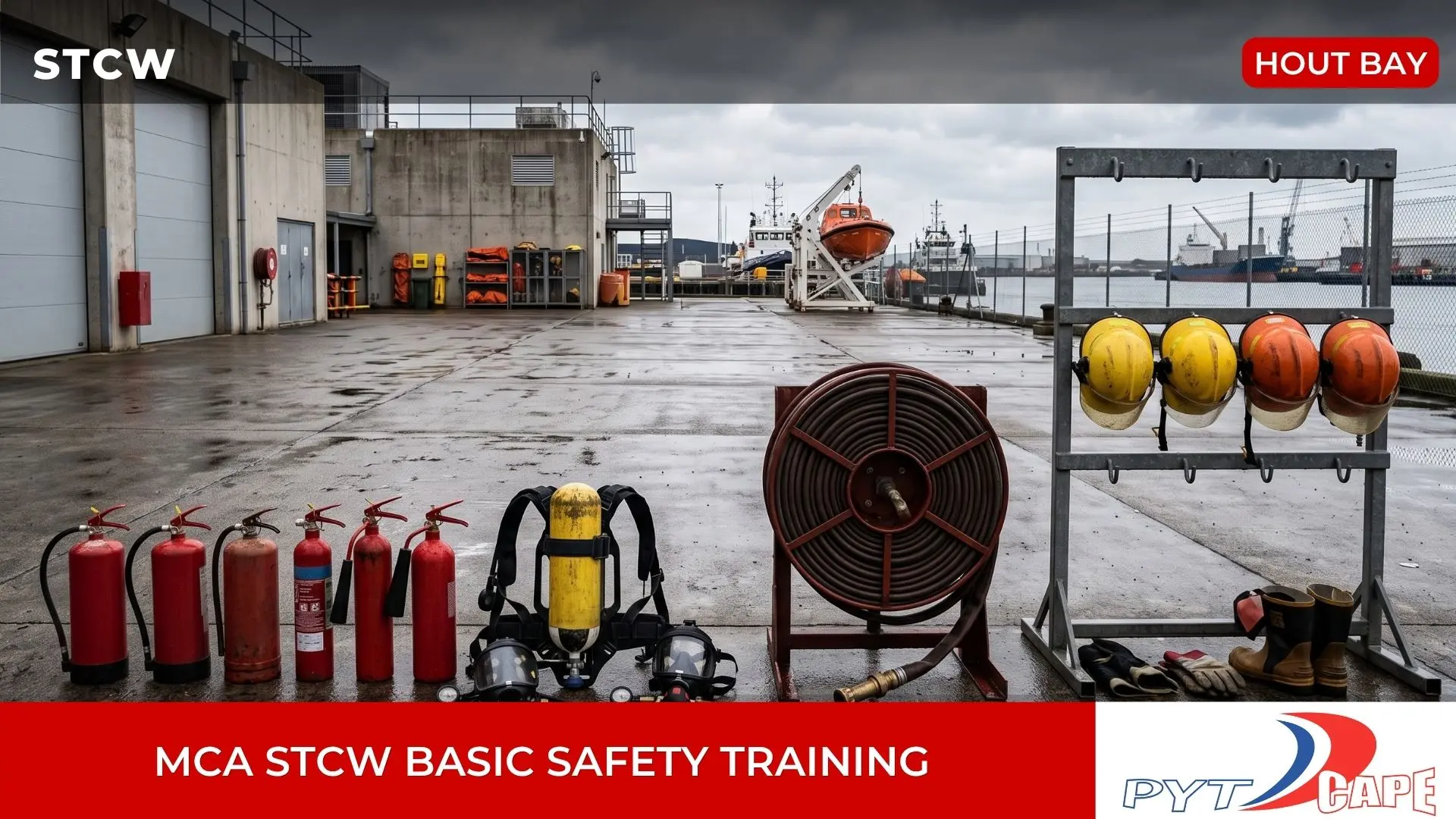
No vessel can legally sign you on without it. Ten days in Hout Bay, five modules, and the certificate every crew agency asks for first.
What the STCW course covers
STCW Basic Safety Training is the entry gate to the entire industry. It is not a qualification that makes you better at a job. It is the one that makes it legal for anyone to employ you at sea in the first place.
The convention sets a minimum standard every seafarer has to meet before joining a vessel, and it exists because the alternative was crews who had never put on a lifejacket in anger. Five modules cover survival, fire, medical response, shipboard conduct and security. Ten days, theory and practical, and no route that skips the practical.
It applies to everyone aboard. Deckhands, stewardesses, engineers, chefs. The vessel does not care what your department is.
For most people it is the first certificate they earn and the one that turns a vague interest in yachting into an actual application. Crew agencies filter on it before they read anything else.
On pricing. The package covers four modules at R15,000. Booked individually, Fire Fighting at R8,250, EFA at R2,750, PSSR at R1,375 and PST at R4,125 come to R18,500. The package saves R3,500 and is how nearly everyone takes it. PDSD is priced separately at R3,000 and covered below.
STCW course content
Ten days across five modules. Classroom theory is followed immediately by practical assessment in each case.
Personal Survival Techniques (PST)
What to do when the vessel is no longer a viable place to be. Abandon-ship procedure, lifejacket and immersion suit use, entering the water from height, swimming and treading water in a survival situation, launching and boarding a life-raft, and righting one that has inverted.
Run in the pool and then in open water. Physically the most demanding module and the one people remember.
Standalone: R4,125. Requires refresh every 5 years.
Fire Prevention and Fire Fighting
A fire at sea has nowhere to go and no fire brigade arriving. This module covers how fires start aboard, why housekeeping is a safety issue rather than a tidiness issue, the classes of fire and the correct agent for each, and the use of breathing apparatus.
Practical drills take place in a live burn facility under controlled conditions.
Standalone: R8,250. Requires refresh every 5 years.
Elementary First Aid
Casualty care when the nearest emergency department is a day's steaming away. Primary assessment, bleeding control, burns, shock, fractures and CPR, framed around injuries that actually occur aboard.
Standalone: R2,750.
Personal Safety and Social Responsibility (PSSR)
The module about living aboard rather than surviving. Shipboard organisation and hierarchy, emergency signals and muster procedures, MARPOL and the obligations that come with operating in the marine environment, safe working practices, and the realities of sharing a small space with the same people for months.
Standalone: R1,375.
Proficiency in Designated Security Duties (PDSD)
Priced and scheduled separately at R3,000, run as a single day following the main course.
Maritime security threats, how to recognise them, the vessel security plan and your part in it, and the procedures for responding. Many superyachts belong to people whose personal security is a genuine concern, and crew are expected to understand why the protocols exist.
Whether you need it depends on your role and the vessel. Worth asking before you book.
Where the STCW certificate takes you
STCW Basic is the floor, not the ceiling. Holding it does not make you employable on its own, but nobody is employable without it.
It pairs with the MCA Yacht Rating as the standard pair of certificates for a first deck contract. Crew holding both can be signed on immediately, which is what an agency wants to see. For interior crew, STCW plus relevant hospitality experience is usually the working combination.
If you are aiming at the deck department, the natural sequence from here runs Yacht Rating, then sea time, then Efficient Deckhand, then Officer of the Watch. Each rests on the one before it.
On validity. The certificate lasts five years. PST and Fire Fighting are the modules that expire, and both have to be refreshed to stay legally compliant. Elementary First Aid and PSSR do not. When yours comes due, the STCW Refresher covers it in two days.
STCW Refresher: keeping your certificate valid
Your STCW Basic certificate is valid for five years. Two of its modules, Personal Survival Techniques and Fire Prevention and Fire Fighting, have to be refreshed before that date for you to stay legally compliant at sea. The STCW Refresher is how you do it.
The course runs over two days, split between survival drills in the pool and open water, and practical fire fighting in a live burn facility. It's shorter than the full course because you've done it before, but the assessments are held to the same standard. You need to show you can still do it, not just that you remember how.
Elementary First Aid and PSSR don't expire, so they aren't part of the refresher.
Upcoming STCW Courses
View More Courses
Events
Calendar of Events
|
Monday
|
Tuesday
|
Wednesday
|
Thursday
|
Friday
|
Saturday
|
Sunday
|
|---|---|---|---|---|---|---|
|
0 events,
|
0 events,
|
0 events,
|
0 events,
|
0 events,
|
0 events,
|
0 events,
|
|
0 events,
|
0 events,
|
0 events,
|
0 events,
|
0 events,
|
0 events,
|
0 events,
|
|
0 events,
|
0 events,
|
0 events,
|
0 events,
|
0 events,
|
0 events,
|
0 events,
|
|
0 events,
|
0 events,
|
0 events,
|
0 events,
|
0 events,
|
0 events,
|
0 events,
|
|
0 events,
|
0 events,
|
0 events,
|
0 events,
|
0 events,
|
0 events,
|
0 events,
|
